Thursday, March 31, 2011

Cracked Wheat Pudding (Lapsi)


Lapsi is a sweet North Indian pudding or porridge similar to the semolina pudding (siro or sooji halwa) I featured previously on this blog. It seems to be most common in Gujarat but is also made in nearby Rajasthan and Maharashtra.

Lapsi is often prepared for Divali and other auspicious events such as birthdays, anniversaries, when opening a new business, or moving into a new home. In Hinduism, it is also made as prasad (Sanskrit for gracious gift), a religious offering to a deity which is then distributed and consumed.

Broken wheat is not refined, and as such maintains the nutrients that are present in whole wheat. It is a complex carbohydrate so particularly suitable for those with diabetes.

There is also a savory lapsi made with spices, chillis, and vegetables which I have never tried.

Serves 12-16

Ingredients
10 ounces unsalted butter ( 2 1/2 sticks)
2lb cracked wheat (also known as dalia, crushed raw wholewheat berry, broken wheat, bulgar)
1 cup fine sweetened dessicated coconut (if you can only find shredded coconut, pulse in a food processor until fine)
1 tablespoon fennel seeds
4 tablespoons golden raisins
8-11 cups water
1/8 teaspoon orange color powder
3 pinches saffron
1 1/2 cups granulated sugar
1 teaspoon cardamom
1 1/2 teaspoons nutmeg
slivered almonds and/or chopped pistachios, for garnish

Directions
1. In a large pot, melt butter. Saute cracked wheat and coconut over medium heat for 15-20 minutes or until fragrant. Do not increase heat as wheat may burn and become bitter.
2. Add fennel seeds and raisins and saute for a further two minutes.
3. Remove from the heat and add 8 cups of water. Be careful as the hot cracked wheat might splatter.
4. Add orange color and saffron and mix well. Cover pot and return to medium-low heat for 20 minutes.
5. Taste the lapsi to see if it has cooked. It should be neither chewy or mushy. If uncooked, add 1 or 2 cups of water and cover. Cook for 10 more minutes.
6. Again taste the lapsi. If it has not cooked, add 1/2 to 1 cup water and cover. Lower the heat if necessary. Cook for 5 minutes. Repeat until the lapsi is cooked.
7. Add sugar, cardamom and nutmeg. Note that lapsi will not cook further once sugar is added.
8. Garnish with almonds and pistachios and serve warm.
9. Lapsi can be stored in the refrigerator for one week or in the freezer for three months. To defrost leave in the fridge overnight. To reheat, add a little water and microwave in a covered dish or heat on the stovetop.

Thursday, February 24, 2011

Sour Cherry Shortbread Hearts


I had planned on making sugar cookies for Valentine’s Day. However, the thought of dirtying my countertops, rolling out dough, baking multiple batches, and decorating the cookies with icing, tipped me towards a simpler solution. I just wanted heart-shaped cookies without the fuss, so I adapted a Martha Stewart shortbread recipe I had encountered several years ago.

I've loved shortbread for as long as I can remember. As a child, I coveted Walkers shortbread fingers in the red tartan box. Later, I baked shortbread in the form of petticoat tails and rounds. I also loved my mother’s nankhatai, a ‘Gujarati shortbread’ that contains cardamom and semolina. Here is a pistachio version and a chocolate swirl version. And here is a favorite shortbread recipe I made for Hanukkah.


Shortbread is a Scottish treat traditionally made with one part sugar, two parts butter, and three parts flour. The modifier ‘short’ is an archaic synonym for crumbly; which is due to the high butter content. This is also the origin of the word shortening. Shortbread is baked at a low temperature to avoid browning.

The use of powdered sugar instead of granulated white sugar contributes to the incredibly delicate, melt-in-your-mouth quality of these cookies. This recipe makes just enough hearts for one or two people to indulge and it requires very little cleanup.


Makes 14 cookies

Ingredients
1 cup (2 sticks) unsalted butter, at room temperature
3/4 cup powdered sugar
1 teaspoon vanilla extract
4 drops red food coloring (optional)
1/2 teaspoon salt
1 3/4 cups unbleached all-purpose flour
1/2 cup dried sour cherries or other dried fruit, finely chopped

Directions
1. Preheat oven to 325F.
2. In a large bowl, mix butter and powdered sugar with a wooden spoon. Add vanilla and food coloring and mix well.
3. Add salt and flour and mix until combined. Fold in cherries and mix well.
4. Transfer dough into a 9-inch square, ungreased baking pan. Pat dough with fingers until it is evenly distributed in the pan. Bake for 20 minutes or until shortbread turns brown at the edges.
5. Allow to cool for 20 minutes. Then cut out cookies using a 2-inch heart cookie cutter. The shortbread is very delicate. Use a sharp knife to gently trim stray cherries from cookie. Use a smaller cookie cutter for trimmings.
6. Store cookies and trimmings in an airtight container in the refrigerator for up to a week.

Saturday, January 15, 2011

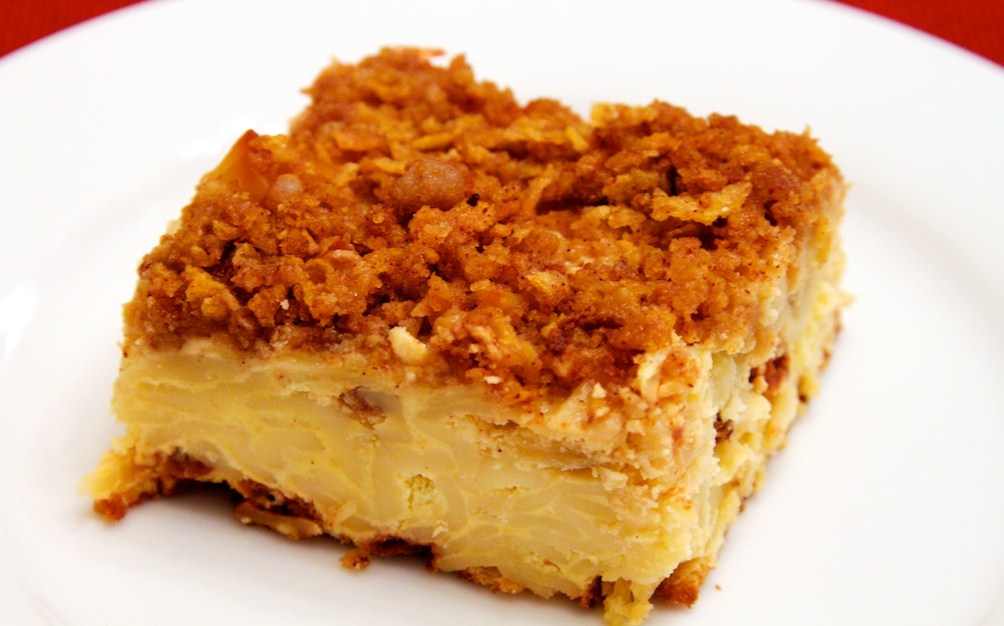
Noodle Kugel


Noodle kugel is an Ashkenazi Jewish casserole usually served as a side dish or a dessert. It is often prepared for the Sabbath and holidays.

Kugels were originally savory cakes made with flour. Eight hundred years ago, the flour was replaced with noodles or farfel; dairy products were added to create a custard-like consistency. More recent versions may contain raisins and cinnamon.

Kugel comes from the German word ball, since the dish was originally baked in a round pan. Contemporary kugels are most commonly baked in square or rectangular dishes.


Serves 12-16


Ingredients

12 ounces egg noodles
6 eggs
16 ounces small curd cottage cheese
4 ounces cream cheese
8 ounces sour cream
3/4 cup unsalted butter (1 1/2 sticks), melted
3/4 cup granulated sugar
1 tsp vanilla extract
1 or 2 Granny Smith apples, peeled and diced
1/2 cup golden raisins (optional)
1 cup corn flake crumbs
1/2 cup brown sugar
1 teaspoon cinnamon

Directions
1. Cook noodles according to instructions on packet. Drain and rinse with cold water.
2. In a large bowl beat eggs and add cottage cheese, cream cheese, sour cream, 1/2 cup butter, granulated sugar and vanilla. Beat well.
3. Gently fold in noodles, apples and raisins.
4. Pour into a greased 9 x 13 Pyrex dish.
5. In a small bowl mix corn flake crumbs, brown sugar and cinnamon. Add 1/4 cup melted butter and mix well. Sprinkle mixture on top of kugel.
6. Bake at 350F in a preheated oven for 75-90 minutes or until the topping is a rich golden brown.
7. Cool at room temp for 15 minutes. Serve warm.

Sunday, December 19, 2010

Peppermint Brownies


One of the best things about Christmas is that it’s associated with some of my favorite flavors and tastes – gingerbread, orange, chestnut, and peppermint. Last weekend I was craving Killer Brownies but wanted to make them seasonal, so I created a holiday version infused with peppermint. This is a combination I’ve tried once before – check out my Pepppermint Perfection Nanaimo Bars.

Peppermint is prized for its leaves and stems which are used to flavor and scent tea, candies, chocolates, chewing gum, cosmetics, and toiletries. Peppermint has a long tradition of medicinal use. It has been shown to repel insects, enhance memory, treat headaches, relieve skin irritation, act as a decongestant, relax muscles, kill bacteria and viruses, and mitigate digestive disorders.

The plant is indigenous to Europe and Asia and is a sterile hybrid of watermint and spearmint. It has been widely cultivated in the New World and is now considered invasive in Australia, New Zealand, Galapagos Islands and the United States.


Makes 48 squares

Ingredients
6 ounces peppermint candy canes
1 lb unsalted butter (4 sticks)
33 ounces semi-sweet chocolate chips
7 large eggs
2 cups granulated sugar
1 tablespoon vanilla extract
1 tablespoon peppermint extract
1 1/3 cup unbleached flour
1 tablespoon baking powder
1 teaspoon salt

Directions
1. Unwrap and break candy canes into 1-inch pieces. Crush with a mortar and pestle. Alternately, lay pieces flat in a large Ziplock bag and use rolling pin or wine bottle to crush. The goal is to break candy canes into smaller pieces (1/8-inch in length) and not to crush into a powder. Set aside.
2. Butter and flour a 3/4 to 1-inch deep 12 x 18 inch baking sheet. Preheat oven to 350F.
3. In a medium pan over lowest heat, melt butter and 12 ounces chocolate chips. Mix thoroughly and set aside to cool slightly.
4. In a large mixing bowl, beat eggs (with a fork, do not use an electric beater), then add sugar, vanilla, and half the peppermint extract. Add chocolate mixture and mix well using a spatula. Allow to cool to room temperature.
5. In a small bowl mix all but 2 tablespoons of flour, baking powder and salt. Using a spatula, fold flour mixture into the chocolate mixture.
6. Toss 3 ounces crushed candy canes and 12 ounces of chocolate chips in reserved 2 tablespoons of flour. Fold these into the brownie batter with a spatula.
7. Pour batter into the baking sheet and bake for 30 to 40 minutes or until a toothpick inserted in the center comes out clean. Halfway through the baking, remove baking sheet and drop on countertop or floor several times to remove air bubbles. Be careful not to overbake these brownies – they should be moist and chewy (not cakey).
8. When brownies have cooled to room temperature, melt remaining 9 ounces of chocolate chips in microwave. Mix in remaining 1/2 tablespoon peppermint extract. Using a knife, spread thinly on baked brownies. Immediately garnish with remaining 3 ounces of crushed candy canes.
9. Cool to room temperature and refrigerate overnight. Using a pizza cutter or knife, cut into squares.
10. In an airtight container, brownies will last in the refrigerator for two weeks. To freeze, wrap individually in plastic wrap and store in an airtight container for up to six months.